What Building Owners Need to Know About the Legal Challenges to Building Performance Standards
NOTE: This blog post will be updated shortly. Significant additional rulings were published on 4/1. In the interim, learn more about those rulings here.
If you own or manage a large commercial building in Washington state, you have probably heard (or said) at least one of the following:
• 'Building performance standard laws will get struck down in court — wait before spending money on compliance.'
• 'Other cities are getting sued; the same thing will happen here.'
• ‘Let’s just pay the fine, if they even issue fines…’
As Washington's first compliance deadline for the Clean Building Performance Standard is this summer (2026), these arguments are circulating more widely than ever. So, we did the research so you don’t have to, and studied all the major legal challenges to building performance standards currently pending in the US. And here’s our general take:
Instead of “waiting for the litigation,” consider a reframe: understand the likelihood of litigation in Washington state (relatively low), and at least (1) determine if your building is in scope (and any potentially applicable exemptions), (2) assess your risk exposure (cost of compliance versus cost of penalties versus market impacts versus benefit of any incentives), and (3) make an informed decision from there.
The Background
Legal Theory: EPCA Preemption
The central legal argument in virtually every BPS lawsuit is the same: the federal Energy Policy and Conservation Act (also known as EPCA) preempts state and local building performance and emissions standards. This theory quickly gets tied in with “natural” gas bans, but for the sake of brevity, we will stick with BPS litigation in this blog post (though the issues are related, you will see why in a minute).
EPCA was enacted in 1975, and it creates federal efficiency standards for covered appliances (water heaters, furnaces, stoves) and “preempts” state regulations that concern the “energy efficiency or energy use” of those appliances. Preemption is a 50-year-old legal doctrine, and it makes sense in certain contexts: it creates consistency across the states, or uniform national rules for things that cross state lines. Consistency is helpful when a “patchwork” of legislation in 50 different states would, for example, make the manufacture and sale of products (like major appliances) difficult if every state had different rules.*
The legal theory that EPCA could invalidate BPS laws originated with a 2023 Ninth Circuit decision, California Restaurant Association v. City of Berkeley, which struck down a Berkeley ordinance prohibiting gas infrastructure in new buildings.
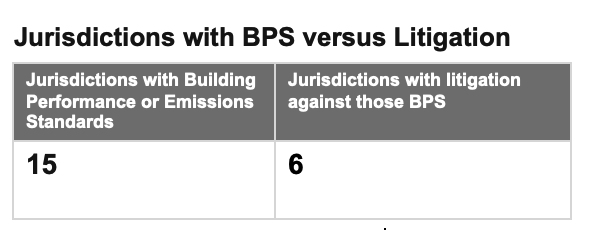
Source: IMT BPS Matrix, March 2025.
As noted by one commenter, the relevance to BPS litigation is that, “Generally speaking, EPCA preemption has been considered to preclude only state or local regulations that try to set energy efficiency standards for EPCA-covered appliances. However, in California Restaurant Association v. City of Berkeley, the Ninth Circuit held that EPCA also preempts certain kinds of regulations that are not efficiency standards, but which have the effect of preventing the use of EPCA-covered appliances.” (source, emphasis added).
Industry groups quickly tried to apply that ruling to challenge BPS laws across the country. There are at least two key points to keep in mind from the Berkeley case:
The facts in that case involved: gas and new buildings (as opposed to overall building performance and existing buildings).
The Berkeley decision only binds certain courts (meaning courts have to follow the logic and holding), and many that are not bound are openly rejecting the Berkeley interpretation, limiting its scope and impact.
What the Pattern Tells Us
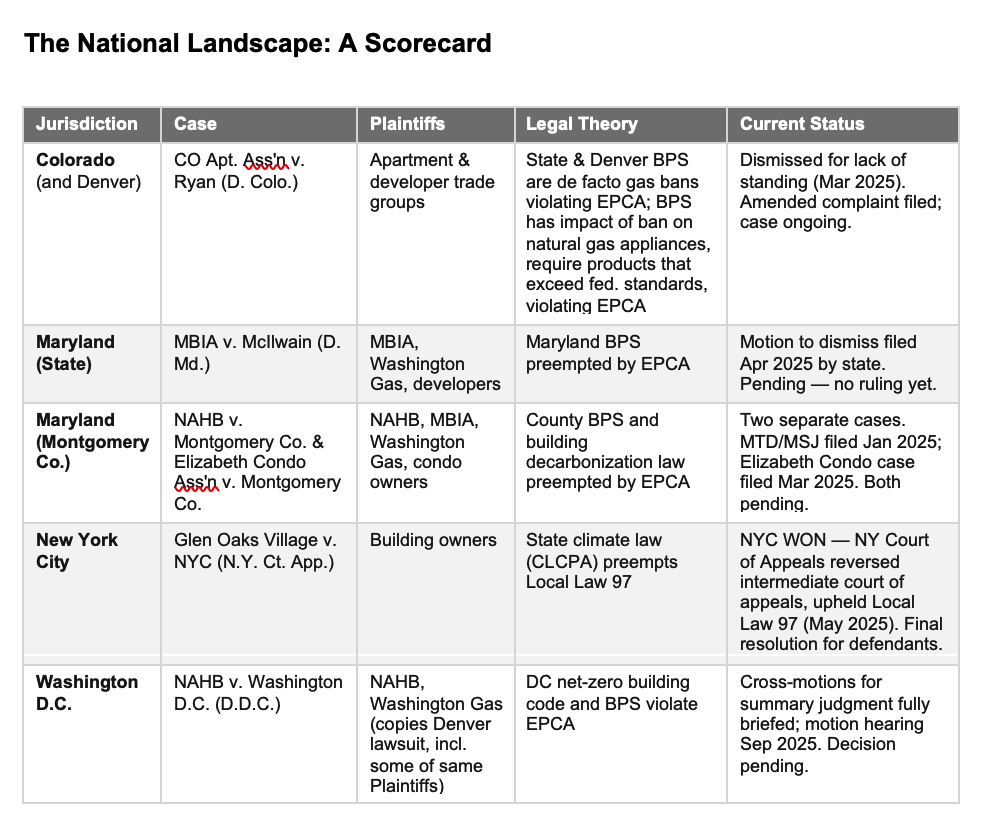
This is a summary, always check for the latest updates.
To the right is a chart summarizing BPS litigation thus far:
Several themes emerge when reviewing all of these cases together:
1. Courts tend to reject Berkeley’s broad interpretation of EPCA.
The Southern District of New York, the Northern District of New York, and others have explicitly declined to follow the Berkeley reasoning. They are applying EPCA more narrowly, finding that it governs appliance efficiency standards, not building-level performance requirements. The Berkeley case is also binding only within the Ninth Circuit's territory (which does not include Washington state courts).
2. Building Performance Standards are legally distinct from gas bans.
Side Note: Washington state does have a gas ban (I-2066), which is currently pending direct review by the state Supreme Court. Washington state also has 2012 precedent regarding EPCA-driven challenges to state building code amendments designed to improve efficiency in residential construction. (BIAW v. Washington State Building Code Council). Regarding the state building code, the Ninth Circuit found that the code requirements fell under an exemption to preemption (meaning they could stand). If you want to go down that rabbit hole, here are two resources Climate Case Chart and Public Health Law Center.
The Berkeley case involved an ordinance that flatly prohibited gas infrastructure in new buildings. BPS laws like Washington's Clean Buildings Performance Standard, and Seattle’s Building Emissions Performance Standard do not outright prohibit any fuel or appliance. Instead, they set performance targets for entire buildings, with multiple compliance pathways (thus the name, Building Performance Standard). The CBPS sets an EUI target and BEPS sets a GHGI target, and courts have consistently found this distinction matters. A good explanation of EPCA, and the Berkeley ruling is available from the Public Law Health Center.
3. The plaintiffs generally lose on standing.
The Colorado case was dismissed entirely because the plaintiffs could not show they had actually been harmed (though it was amended). This is a recurring problem for challengers: speculative future harm — “the BPS might force us to do this someday” — is not enough to get into federal court.
Standing is the idea that courts generally do not address potential or hypothetical harm, but only real disputes between real parties; a plaintiff does not have “standing” until they have suffered an actual injury, caused by another party, and that the court can fix or resolve. You can imagine the practical implications if we did not have standing rules, courts would be flooded with requests to review and rule on hypothetical issues.
Standing issues can (sometimes) be fixed, for example if time passes and circumstances change, or if plaintiffs amend their pleadings to demonstrate that they would be forced to use specific appliances to meet the standards (as happened in the Colorado case). The issue in Washington state is that any potential plaintiffs could likely only allege speculative harm based on potential future compliance costs or the idea that legislation would “effectively” require plaintiffs to use specific, more energy efficient appliances - we just aren’t there yet, and so far those arguments have not been well received.
4. Washington state and Seattle are not currently facing BPS lawsuits.
As of March 2026, neither Washington's CBPS nor Seattle's BEPS are subject to a pending federal lawsuit.
Even if litigation were attempted, potential plaintiffs would likely face an uphill battle, for several reasons. First, potential plaintiffs could run into standing issues, for the reasons outlined above. And there are also more states and local governments with BPS laws than there are lawsuits. IMT, Comparison of US Building Performance Standards. Second, as litigation works its way through the courts, state and local governments are learning how to craft BPS laws to avoid litigation; Seattle likely directly benefitted from lessons learned and Washington is in that process.
Seattle’s BEPS was signed into law December 2023; the city had the benefit of learning from BPS enacted prior, including Boston, Chula Vista, Colorado, Denver, Maryland, Montgomery County, New York, St. Louis and Washington D.C. That’s a lot of learning and knowledge sharing from these entities, including knowledge shared as part of the National BPS Coalition (Seattle was a member).
And while Washington state’s CBPS was the first state-wide BPS, the state is now going through a rule making process which focuses on key areas relevant to potential litigation. HB 1543 focuses on extensions and exemptions, alternative compliance pathways, and clarifying language. Department of Commerce, HB 1543. If you‘ve been following along, revisions to these aspects will likely make litigation more difficult because they provide greaater flexibility related to pathways to compliance.
What This Means for Washington Building Owners
Based on the summary chart, above, we would generally categorize the litigation to date as uncertain at best, with at least one case (NY) decided in favor of the BPS standing.
The strategy of “wait and see” is particularly risky when we look at the overall risk context, meaning that potential litigation is not the only piece of the puzzle. There are various additional considerations related to compliance:
• Climate risks are real, increasing in frequency, severity, and costs, and physical assets like buildings are at high risk. Building Performance Standards are a key part of the decarbonization puzzle, designed to reduce the source of climate change; yes, that’s longer term, big picture thinking, but that’s what today’s world requires. There’s regulatory compliance and then there’s smart risk management; investors, insurers and others are paying attention and the risk of non-compliant, stranded assets, is real.
• Related to the above point, high carbon buildings also face other risks, including increasing insurance costs (and lack of availability), and they are less attractive to the increasing number of tenants and investors with decarbonization goals.
• Penalties for non-compliance are real and escalate over time. They are generally based on square foot, which means that larger buildings face larger exposures.
• Early compliance has real financial benefits. Washington's Department of Commerce has offered Early Adopter Incentive programs for Tier 1 and Tier 2 buildings — money that is not available to those who wait.
The Bottom Line
The national litigation picture generally does not support a “wait for the litigation” strategy. The trend is in favor of BPS laws surviving legal challenge, and Washington and Seattle are well-positioned, if a legal challenge was filed.
If you are a building owner or manager in Washington state and are not sure where you stand on CBA or BEPS compliance, now is the time to find out — not after a penalty notice arrives.
Depending on client need, we generally provide building owners with the following services:
- Analysis of whether buildings are in scope, and any potentially applicable exemptions.
- Identification of relevant timelines and documentation requirements.
- Guidance regarding paths to compliance and related strategic decisions.
*The irony is that building performance standards, despite including the word “standard” in their name, are not standardized, and the “patchwork” that has been created in different states is causing compliance challenges, particularly for portfolio owners with assets in multiple BPS jurisdictions.
Sources and Resources
Colorado:
Public Law Center, EPCA Background
Maryland (state):
Maryland (Montgomery County):
Public Law Center (Elizabeth Condo.)
Public Law Center (National Assoc. Homebuilders)
Climate Case Chart (Elizabeth Condo.)
Climate Case Chart (National Assoc. Homebuilders)
New York (city)
New York (state)
DISCLAIMER: this blog post / resource is provided as a free resource to communities who need information on these topics. It contains general information, for educational and informational purposes only. It is not legal advice, and is not a substitute for retaining a lawyer in your jurisdiction to address your specific needs. Every project and every lease is unique and the law is inherently fact specific. General information, including this blog, should not be used as a substitute for competent legal advice from a lawyer you have retained and who has agreed to represent you.
This post was produced with the support of AI tools, with significant human oversight, intervention, and review.